I’ve been thinking about this question/statement for the good part of seven years now, (at least since we started the farm at Ololo) and I know I’m certainly not the only one! Anyone who cares about climate change, biodiversity loss, human health, animal welfare or simply where our food comes from and how its grown has probably given it some thought too. We all hear the same old, boring rhetorical question; How on this earth are we going to feed a growing population without destroying the very planet that feeds us? It’s a pretty big question. In fact I reckon it’s probably one of the biggest challenges humanity faces.
The reality is, after decades of agricultural innovation, mechanisation and trying to produce more food for less, we’re now almost having to reverse engineer the whole thing. Unlearning what we’ve learnt, and trying to figure out how to grow food in a way that actually works with nature rather than against it. There’s a million different opinions on how we should go about doing this and governments and farmers from all over the world should be asking themselves this exact question question. But for this discussion I want to focus on one particular subject. Animals. And more specifically, the role they can play in rebuilding our soils and making our farming systems more sustainable.
Farmers Are Treating Soil Like Dirt
I’ve had countless conversations, heated arguments and debates about this over the years and certainly bored a so many people along the way too. In fact, I’d given this subject so much thought that back in 2019 I was invited to speak in front of over 1,000 delegates at EvokeAG – where i was selected to be the voice for youth in agriculture as am agricultural graduate. Evoke is one of Australia’s largest agricultural events. My pitch was pretty simple. “Farmers are treating soil like DIRT.”
This topic was deliberately provocative and I remember walking off stage after only a 5 min presentation with more questions coming from conventional farmers than from those already involved in the regenerative agriculture movement in Aus. Which was actually a good thing. The whole point was to get people thinking.
Fast forward seven years on and the animal agriculture versus vegan debate is as heated as ever. On one side we’re told animal agriculture is destroying the planet and we should all be eating plants. Yet, on the other, we’re told livestock are essential to healthy farming systems and ecosystems. I think there are some pretty good arguments on both sides though I’m certainly not here to tell anyone what they should or shouldn’t eat- That’s entirely up to you! But I do think there’s one rather important ingredient that’s been massively forgotten in this whole debate, and it’s right beneath our feet. SOIL.
So What’s So Special About Soil?!
For starters, soil is one of the largest carbon sinks on the planet. There’s more carbon stored in the world’s soils than in the atmosphere and all the trees and plants above ground combined. And we have spent years talking about carbon emissions, electric cars, renewable energy and planting trees. All important things of course, but perhaps we should be paying a little more attention to this ‘dirt’.
I’m not suggesting we can just put a few cows in a paddock and solve climate change. But the way we manage agricultural land (with livestock) can have a huge influence on how much carbon is stored in our soils, how well soils retain water, and ultimately how productive farms become. There is some pretty interesting research now showing how improving soil management, keeping living plants in the ground (green manure, Nitrogen fixing cover crops) and restoring degraded farmland can help draw carbon out of the atmosphere and store some of it in the soil. Of course, there are limits to how much carbon soils can store, and it doesn’t somehow cancel out all the emissions from agriculture. One cool fact is that for every 1% increase in soil organic matter, there is an 8% increase in water infiltration’, which in times like Kenya’s short rain season now – matter more than ever!
And this is where I think animals have a really interesting role to play as they help fertilise a paddock by depositing their urine, manure and natural animal impact of hooves for grazing herds, helps break down dormant grass species and regenerate new growth of diverse plants/ grasse species. Now rather than getting bogged down in science, I want to share a few practical examples of what we’re trying to do at Ololo Farm in Kenya. Because I reckon sometimes it’s easier to understand these things by actually seeing them happen on a farm rather than reading an opinion piece.
Pigs Are Tractors You Can Eat
I wrote my previous post a while back describing pigs as “tractors you can eat once they’ve finished tilling the soil.” And I wasn’t joking! Anyone who’s spent a bit of time around pigs will know they have an extraordinary ability to turn over soil with their snouts. They really are remarkable tractors (and no desiel costs required). For centuries pigs have been used to clear vegetation, disturb ground and prepare land for planting new crops.
At Ololo, we use our pigs as part of our land management. They help clear areas of vegetation, turn over organic matter and devour food waste converting it into bacon. Essentially doing some of the work a tractor and disc plough might otherwise do. And the beauty of it? No diesel required. Plus you end up with some pretty good, free range pork at the end of it. Now of course, pigs can also make an absolute mess of a paddock if you leave them in one place for too long. And excessive soil disturbance, whether from pigs or tractors, isn’t necessarily a good thing either. So it’s all about management of the animal. Knowing when to move them, when to give the land a rest and what you’re actually trying to achieve. Or more simply put; ‘Its not the cow (livestock) but the ‘how‘.
While those pigs are busy rooting around, they’re also depositing manure and urine back onto the soil. Which brings me to what I think is one of the most overlooked roles animals play in agriculture. Nutrient recycling. Whether it’s a cow, sheep, pig or chicken, animals have this rather useful ability to consume plants and organic matter, and return nutrients back to the soil. Their manure can feed a whole world of soil organisms, from bacteria and fungi to earthworms and other soil insects/ dudus that most of us never really think about. These organisms help break down organic matter, release nutrients and support the next generation of plant growth. It’s nature’s way of recycling really. Another fun fact is that there are more living microrganisms in a teaspoon of soil than there are people on earth! Over 8 billion!!
So as farmers we’ve spent decades developing synthetic fertilisers and increasingly sophisticated machinery to do jobs that animals and natural ecosystems have been doing for thousands of years. That’s not to say fertilisers and machinery don’t have their place in farming.. They certainly and absolutely do, and I certainly wouldn’t pretend otherwise. But perhaps we’ve become a little too reliant on them, and forgotten some of the natural processes that make a farming system function in the first place.
It’s Not About Having Animals. It’s About How You Manage Them.
I’m certainly not suggesting that all animal agriculture is good for the environment. As poorly managed livestock can cause enormous damage. Overgrazing, soil compaction, deforestation, pollution and greenhouse gas emissions etc etc are all serious ongoing issues. And I think the livestock industry needs to be honest about that.. But equally, growing crops without animals doesn’t automatically make a farming system sustainable either. You can grow a paddock of oats or wheat using large amounts of synthetic fertiliser, pesticides, diesel and intensive tillage. Or you can grow crops using compost, cover crops, crop rotations and very little external input. A well-managed livestock grazing system can improve ground cover, recycle nutrients and help rebuild soil organic matter. A poorly managed one can destroy it! And while livestock aren’t the only way to achieve healthy soils, I reckon we’re mad to ignore the role they can play.
What We’re Trying to Do at Ololo Farm
At Ololo we’re certainly not claiming to have all the answers. Far from it! We’re constantly experimenting, learning and occasionally getting things completely wrong. But that’s farming. Our philosophy is pretty simple. We want to build a farming system where animals aren’t just producing meat, milk and eggs, but are actually contributing something back to the land.
Our pigs help prepare our small paddocks for growing new pasture species or fodder crops. Our chickens scratch through organic matter, eat insects and deposit manure. We compost waste and try to return as much organic material back to the soil as possible. Ultimately trying to build a close looped system where one part of the farm supports another, rather than treating everything as a seperate enterprise.
And one of my favourite examples of this is happening right now as we are graciously recieving Novermber’s short rains. We’ve recently planted a crop of Napier grass, which our dairy cows will soon be feasting on. But what’s interesting isn’t necessarily the grass itself, it’s what was happening on that paddock or piece of land before we planted it. Previously, we’d been moving our mobile chicken coops and pigs across the same area.So while these animals were busy foraging, grazing, rooting around and generally doing what pigs and chickens do best, they were also leaving behind a rather useful deposit. Manure. And alot of it! All those nutrients are now helping grow what I’d call a pretty impressive ‘super crop’ of Napier grass, which will soon be fed back to our dairy cows. So our lovelt herd of fresian and jersey cows contine to produce milk as well as even more manure and more nutrients that we can put back into the farming system.
And this is really my point. Without those chickens and pigs, we’d likely have to bring in fertiliser, compost or some other external input to get the same level of growth from our Napier grass. Instead, in this case our laying hens and herd of approx 80 pigs have been doing some of that work for us. Fertilising the land, adding organic matter and helping create the conditions for a healthier, more biologically active soil. It’s not rocket science, but it’s something I find pretty fascinating as we contineu this regenerative agriculture experiment.
And we’re trying to take this a step further. We’ve also been pumping nutrient-rich water from our tilapia fish ponds onto the same Napier grass fodder plot. The idea is pretty simple. Rather than letting all those nutrients from the fish ponds go to waste, why not use them to fertilise the shamba or grow another livestock feed? So the nutrients from our fish ponds are helping grow the napier grass, which will then feed our dairy cows, which will hopefully help us produce more milk. And then of course the cows produce manure, which can go back into the farming system… maintaining the closed loop system.
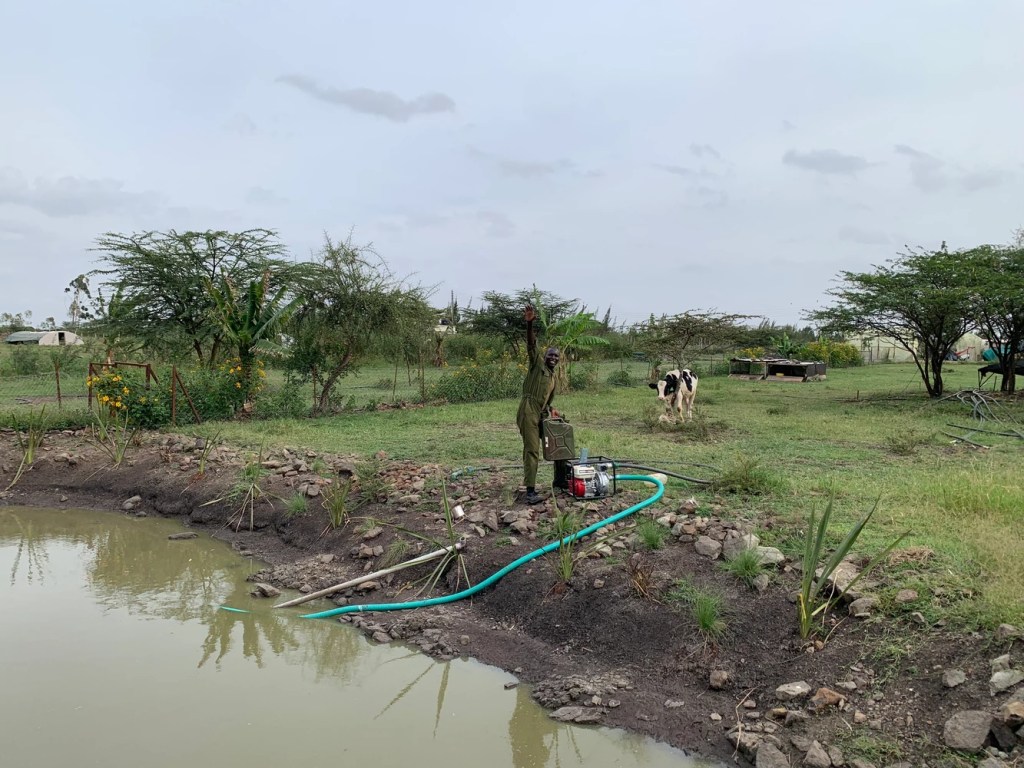
(Photo above – circa 2022) Kioko at the fish ponds trying to fix our pump so we could continue irrigating the fodder plot. A fairly ordinary day trying to fix broken things! But in this case – taking what might otherwise be considered waste from one part of the farm (waste water off the fish ponds) and using it to improve production somewhere else. And hopefully, with more Napier grass available, we can increase the amount of feed available to our dairy herd and improve milk yields from each cow. Less money spent buying in supplemented feed and synthetic fertilisers, and more of the nutrients already on the farm being used effectively.
What I find so interesting about regenerative agriculture is not necessarily about some fancy new technology or completely reinventing the way we farm. Sometimes it’s simply about looking at what you’ve already got and figuring out how to make better use of it!
Which brings me back to the whole animal agriculture debate. Rather than simply blaming livestock for the environmental problems associated with conventional or modern farming, perhaps we should be looking more closely at how we can actually use livestock as a tools to improve our farming systems. Because animals aren’t just there to produce meat, milk and eggs. When managed properly, they can help recycle nutrients, support soil biology, reduce our reliance on external inputs and ultimately improve farm productivity. And that’s something I think gets overlooked massively.
So, Can Agriculture Give Up Animals?
Well, technically yes. There are farming systems that can maintain healthy soils without livestock, and plenty of ways to recycle nutrients without animals. But should we be trying to remove them altogether? I’m not so sure.
And I guess that’s really what I’ve been trying to get at… It’s not necessarily about whether we should or shouldn’t eat meat. That’s a personal decision and one I’m not particularly interested in arguing about. It’s more about recognising that animals have a pretty important role to play in a healthy agricultural system, beyond simply being a source of nutrient dense food.
At the end of the day, whether you’re vegan, vegetarian or enjoy a good steak, we all depend on the same thing. Healthy soil.
And I reckon that’s where we should probably be starting the conversation.
George
Ololo Farm


Leave a Reply